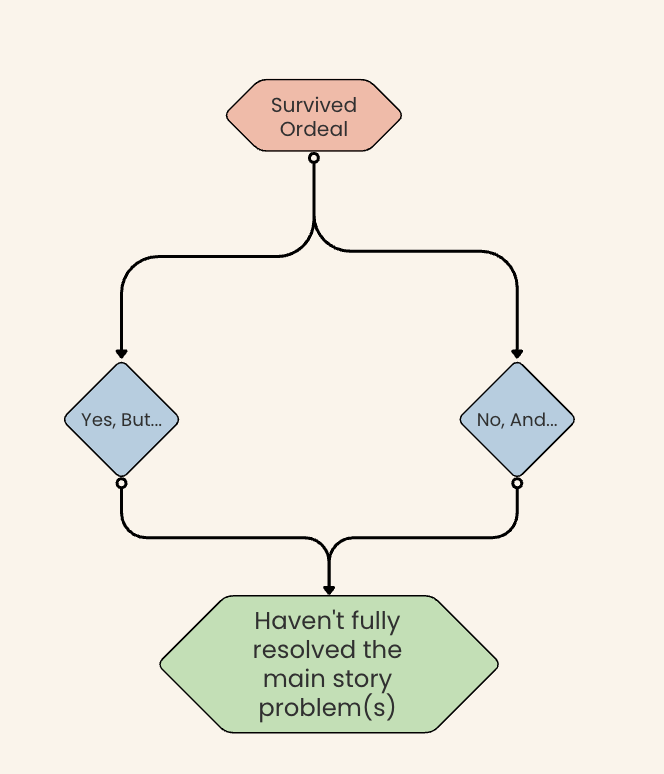
There’s still a lot of work to be done. Remember our Try-Fail cycle of ‘Yes, But…’ or ‘No, And…’.
Wait, what? You mean there’s more work for the MC and their plucky band? Oh, yes. Yes, indeed, but not to worry, dear writer, because you already know how to do this next bit. You did it way back in the beginning.
This next piece echoes or reflects the Inciting Incident, the Call to Adventure, and maybe the Refusal of the Call. Again, your watchword here is BREVITY as these elements should be even faster to get through this time around for a couple of reasons:
Your readers have been here with these characters before. Don’t bore them with the same or similar concerns they read about in Chapter 3.
Your characters have grown and changed. They don’t have the same flaws as before so while the challenge may be thematically similar, the MC is more capable and needs a bigger, badder test.
If there is hesitation, it won’t be for the same reasons. Remember, your MC is a better version of themself. Where once Mr. Milquetoast would have trembled at the idea of telling the barista he wants oat milk, please if it’s not to much trouble, now he confidently orders his beverage of choice because, gosh darn it, he’s been to heck and back. The man has seen some shiz!
Your job in the Road Back is to set the stage for the final confrontation. Good vs. Evil. Red vs. Blue. Star Wars vs. Star Trek*
What this means is you need more conflict, higher stakes, a shorter clock, fewer allies, more/worse enemies, etc. Also, it’s probably raining…
Essentially, this means dangling Happily Ever After over your MC’s head and then snatching it away, only to replace it with a grenade sans pin. Yes, the Road Back is on heck of a reversal of fortunes and it happens fast!
Ask yourself:
What were MC’s wants at the start? What are they now?
What were MC’s needs at the start? What are they now?
Friends/Foes gained or lost – who’s still on the stage at this stage?
Baddies – how have they gotten worse, more powerful, more dangerous?
Writing exercise
Writers are sadists extraordinaire as any of our characters can attest, so put on your most evil thinking cap, chuckle your most diabolical chuckle, and ominously stroke a house pet.
Now, to the writing!
Write a scene where your MC is trying to do something, but is prevented by at least three things. When they attempt to resolve the situation, make it worse.
For example, Gwen wants to pick up flowers for her girlfriend, but (1) her favorite florist shop is unexpectedly closed, (2) she can’t order online because her credit card is locked for [story reasons], and (3) the only flowers at the gas station are lilies, which her girlfriend is deathly allergic to! Frazzled, Gwen remembers that graveyards always have beautiful arrangements and her girlfriend is a bit Wednesday, so she might actually like those flowers better. Despite her moral objections, Gwen decides to raid the local cemetery. She parks in the back and makes sure no one else is around. Just as she’s picking up a lovely bunch of roses, she hears someone clear their throat behind her…
*Trick question – the clear winner is Battlestar Galactica
Your MC has faced a great challenge. They have been tested and demonstrated that they’ve learned the lesson they needed to.
It’s time for their Reward, which can be an unexpected boon or something the MC has been struggling to achieve the whole time.
In either case, the MC and their pals get a moment to celebrate, to bask in their glory, to honor their fallen comrades, and to come to grips with what just happened before they move on to the next and final phase of the story (more on that in The Road Back).
But what makes a good Reward?
Should you just shower your MC with gold doubloons and call it good?
Think back to your MC’s starting conundrum. What they wanted verses what they needed. The Reward is most directly linked to what the MC needed. They may also get something they wanted if you’re a very kind writer. I prefer my little darlings suffer a bit more, but that’s just me.
Let’s look at some examples of Rewards and see how they’re tied to what the MC needed and/or wanted.
‘The Postman’ by David Brin
Quick Look – A former Shakespearean actor poses as a postman to gain access to a safe community and finds himself leading the resistance to an authoritarian strongman intent on regional domination
MC – Gordon
Wants – A safe, quiet life
Needs – A higher purpose
Reward – A community, family, love and admiration for generations to come
‘Leech’ by Hiron Ennes
Quick Look – The Institute, a collective of individuals controlled by a hive mind, sends a replacement doctor to a remote château to investigate the death of the previous Institute doctor and contain the parasite there
MC – The doctor
Wants – To find and destroy the parasite Pseudomycota
Needs – To recognize and address systems of oppression and abuse
Reward – A train ride
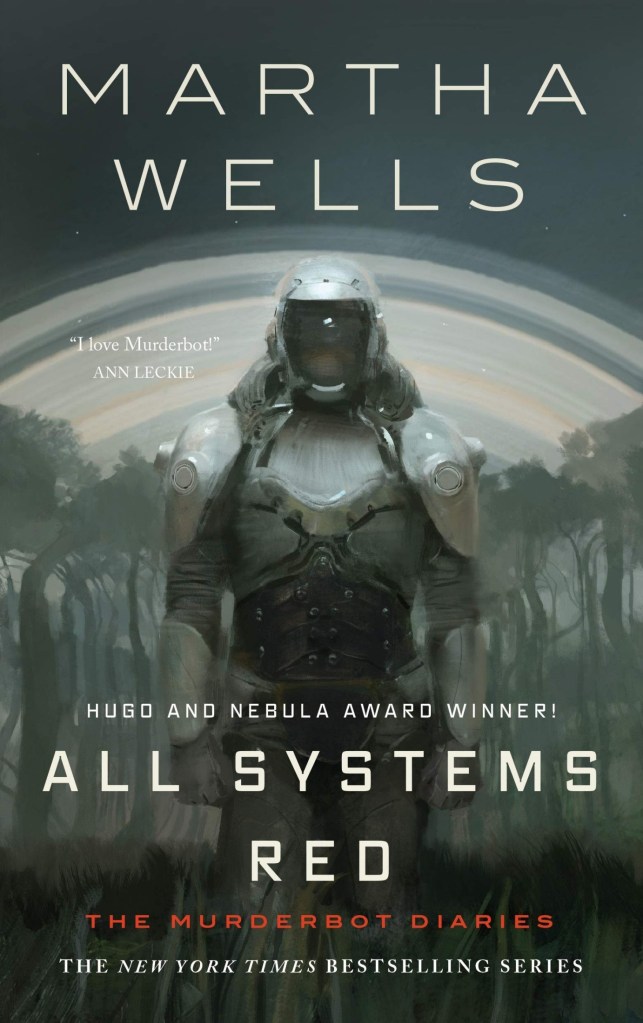
‘All Systems Red: The Murderbot Diaries’ by Martha Wells
Quick Look – After ‘the incident’ a rogue Sec Unit has to pretend to be still under control while protecting their human crew from the threats of an alien planet and trying to catch up on their beloved entertainment serials
MC – A rogue Security Unit AKA ‘Murderbot’
Wants – To be left alone
Needs – To interact with humans and learn to trust them
Reward – A choice
Finding the right Reward for your MC can be a challenge. Consider whether they need a physical object, personal validation, or something else.
Writing exercise
Look around your vicinity and pick out three to five items. Write them down. Add three to five non-tangible things such as family reunited, a work promotion, that knowing nod from a revered role model or external validation, which can take a specific form such as a book contract or movie deal.
Flip the script. What are the bad versions of the items? What are the bad versions of the non-tangible things?
Write a starting scene where the MC has these bad versions. This is foreshadowing. Once you know the end you’re working toward in the story it’s easier to connect those points.
If you’re a plotter by nature, you’ll do this before you start writing or fairly early in the process.
If you’re the kind of writer who just sits down with a vague idea and a bundle of inspiration, great! But you’ll have to do this kind of work during the editing phase. Make peace with the fact that some stories meander and will require a lot of editing.
And now, the moment we’ve all been waiting for: The CLIMAX!
Also known as the Ordeal.
Much like Crossing the Threshold, the time for thinking, worrying, planning, and/or preparing has passed. Time for the Main Character(s) to face their greatest challenge and die! Wait…die?
Heroes aren’t heroic because they win.
They are heroic because they are willing to risk it all, even their lives, in service to a greater cause or goal.
The Ordeal is where the MC’s resolve is tested. Not everyone makes it to “The End”.
Elements of an Ordeal
Setting – where is the Ordeal taking place? Whatever your first answer, great BUT how can you make it worse? Remember, the writing exercise from the Approach? Let’s say your setting is “while shopping” (16-17 roll). What if a child runs off in the mall/market? What if there’s a fire? What if the shop is all out of whatever the MC most needs?
The Goodies – the MC will definitely be part of the Ordeal, but who else is there? Are they present the whole time or, like the Great Eagles, do they just swoop in all deus ex machina style? Sadly, any mentors who have survived this long are in grave jeopardy during the Ordeal, as there’s often the self-sacrifice of a secondary character to allow the MC to continue on their path. This is also the last chance that untrustworthy “friends” have to betray the MC and reveal their true colors.
The Baddies – stack the deck in their favor. Whether physically, emotionally, or other, the Baddies have the high ground and the Goodies can’t possibly hope to win against those odds. Baddies suffer from hubris, ignorance, or some other flaw that’s directly related to the MC’s starting flaws. Remember, the Baddies are warnings – this is MC’s future if they make poor choices, if they succumb to temptation, if they fail.
Final temptation, offer or chance to turn back:
Join me or die
All this can be yours
If you love me you would/wouldn’t do this to me
I can make all your dreams come true
Death – Death and rebirth are part of the Ordeal. That may be literal, as in many mythologies where a divine being dies and comes back to life. It may be figurative, such as when the MC undergoes such a dramatic transformation that the version of them from the beginning of the story is essentially dead and gone.
Genres where literal death is more likely or more common: thrillers, action/adventure, sci-fi, fantasy, horror, Westerns, historical, literary fiction
Genres where literal death would be very shocking to readers: romance (unless there’s a HEA baby), contemporary fiction, mystery (especially cosy ones)
Outcome – There are three main options and yes, you very creative types are welcome to send me examples that fall outside these categories.
Win – The MC succeeds, whatever that means for them. They may or may not live, but they did win and the story world will forever be better off for it.
Lose – The MC fails, usually because they refused or were unable to learn the lesson of the story’s theme. For example, in Romeo & Juliet, one of the themes is Love Conquers All, but when Romeo finds Juliet apparently dead in a crypt, he despairs and instead of believing in their love, he kills himself. Stories where the MC can’t or won’t change in the way they NEED to are tragedies.
Draw – The MC kind of wins, but also kind of loses. Ambiguous endings frustrate some readers, as do cliff-hanger endings and friends, when you see these endings, you probably have a series on your hands. Keep going and you’ll eventually come to a more definitive resolution.
Legacy – Not all MCs survive the Ordeal and not all those that die rise from their graves, which is good news (unless you like zombies). For MCs who die for REAL and don’t resurrect via magical, mystical or medical means, there is still a rebirth, but it takes the form of legacy in the story. Legacy can be as large as saving the multiverse or as simple as changing the school’s dress code (Hopefully, no one has to die to achieve this!). Sometimes, legacy is physically embodied by a child who is able to carry the MC’s cause forward (cue the convenient pregnancy trope). It can also be shown through the way future generations remember and celebrate the MC.
Writing Exercise
Brainstorm your Ordeal.
What is the setting? Make that worse in at least one way. Not only is the forest haunted, it’s also quite stinky.
Who are the Goodies present?
Take at least one helper away or add at least one additional character the MC must protect and defend to split their focus.
Who are the Baddies present?
Give them at least one more advantage. Make it something outrageous, like “I never miss when throwing with my left foot” or “I can read your mind by watching your microexpressions.”
Remember the Try-Fail cycle from Refusal of the Call? The MC tries to do something and gets a Yes, BUT or a No, AND result.
Think of the best result the MC could hope for. Wonderful, isn’t it? World peace and chocolate cake now grants you three wishes. Just as your MC lifts their fork for that oh so satisfying bite, drop in the BUT. Yes, they achieved world peace, but…
Imagine everything has gone horribly wrong. The love interest turned out the be the main baddie and they never actually liked the MC’s hand-knit scarf. Just when your MC thinks things can’t get bleaker, give them that AND. Did you win? No, and on top of everything else…
The Main Character(s) are well in the soup now, but so far, they’ve been able to handle the tests their enemies throw at them with the help of their friends. They’ve also been learning and developing the skills and knowledge they’ll need to face the story’s main challenge.
The Approach combines a few different elements and sets up the rest of story, foreshadowing the Ordeal. So, what do you need for a good Approach to the Ordeal?
Fear – the MC grapples with their fear. Whether this is linked back to their original reason(s) for Refusing the Call or some other thing they’ve encountered along the way, the Ordeal is about facing one’s biggest fear.
Pause – the MC needs a time to realize what’s at stake if they fail. This is one of the scenes where the MC’s Person verses Self (See Types of Conflict) or inner conflict will be most clearly on the page. Up to now, they might have waltzed around it, but the MC can’t avoid it anymore: They have to fully recognize the situation and choose to move forward anyway.
Villain – Sometimes called “the Shadow” this enemy is the distorted mirror opposite of the MC, their evil twin, if you will. More on the Shadow below.
The Ordeal Itself – What is it that the MC will encounter? The challenge must both externally and internally difficult. It must also be unidirectional (one way). After the Ordeal, the story world will be different no matter what happens.
Here’s where you plotters really shine.
The Approach sets up the Ordeal. This is where you can play around with misdirection or make it glaringly obvious the path the MC will take between now and “The End”.
The Shadow
The Shadow’s role is to both tempt and warn the MC. Often the Shadow seems like a better, more successful, more popular version of the MC. The Shadow offers the MC a chance to get what they WANT at the cost of what they NEED. They are the quick fix to a serious issue. Or the Shadow might be cautionary, even pitiable, if they weren’t so mustache-twirlingly evil.
While the Shadow shares many of the MC’s characteristics, they serve a warning: That is the MC’s destiny if they make the wrong choices. This villain doesn’t need to be THE villain of the story, especially in stories less focused on Person verses Person conflicts. They can appear only briefly or might not be a person at all, but some other form as long as they are a warning.
Let’s look at some literary shadows.
Book
A Deadly Education
The Gunslinger
The Fifth Season
The Bear and the Nightingale
Main Character
Galadriel “El”
Roland Deschain
Essun
Vasilisa “Vasya”
Shadow
Jack
The Man in Black
Schaffa
Konstantin
Below are only a few characteristics to consider when creating an effective Shadow. Generally, Shadows either resemble or counterpoint the MC. Mix and match as your story requires.
Sex and/or Gender
Age – similar or gap?
Race
Socioeconomic status
Physical appearance
Writing Exercise
Pick an Ordeal from your own life – it can be something good such as a wedding, graduation, birth of a child or something you dread, such as a death, major move, or asking for a raise at work.
Consider how you approach your own ordeal. What is at stake? What do you hope to gain? What do you fear to lose? Who is your Shadow and why?
Write a short scene – less than 1,000 please – where you prepare for your Ordeal. Include your emotional state, your location, your Shadow, and what the Ordeal.
Not hard enough? Don’t worry, I got you.
Bonus rolls
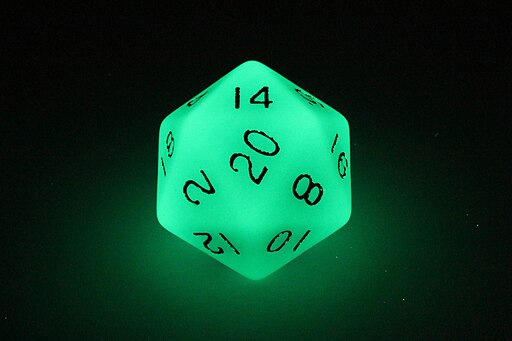
Roll a D20.
For you non-nerds it’s this beauty ➡︎
If you don’t have one, you can use an online dice roller such as Roll A Die.
Roll
Genre
Roll
Setting
1
Real Life
1
Actual Setting
2-3
Fantasy
2-3
A family gathering
4-5
Thriller
4-5
Aboard a ship
6-7
Romance
6-7
A concert or play
8-9
Mystery
8-9
A haunted place
10-11
Sci-Fi
10-11
In the wilderness
12-13
Adventure
12-13
At a meeting
14-15
Literary
14-15
During a war
16-17
Western
16-17
While shopping
18-19
Sports
18-19
Dream vacation
20
Your Choice
20
Your Choice
Got your rolls? Great.
Now write the scene of you approaching your ordeal using the setting and genre combo you rolled up. For example, you roll a 15 and an 11 – so you should write a literary story set in the wilderness.
I would LOVE to share your results. Please send them to me here.
You are now in Act II (this is where all the fun stuff happens!). Before you start writing the next element of the story, pause to examine how it will differ from the previous ones.
In Act I, you did a lot of set up, introduced the MC, established their needs vs. wants, introduced the main story problem the MC will be addressing, established why they must address it, gave them a helping hand (and/or swift kick in the bum) from a mentor, and then your wee little MC crossed the threshold.
They are officially ADVENTURING!
They grow up so fast…
One of the key differences for MCs in Act II to those of Act I is that they are an active participant in the plot. During Act I a lot of things were happening to the MC and they were largely reactive. During Act II, events will still happen, but now the MC is acting according to their own agenda, motivated by their own goals.
Act II is all about Try-Fail cycles. It’s also all about the friends, frienemies, and enemies the MC makes along the way.
Enemies
Enemies come in two varieties: Villains and antagonists.
Both villains and antagonists are the MC’s enemies. Both villains and antagonists cause conflict of the Person vs. Person variety (more on that below). So, what’s the difference?
Let’s start with the role of the villain in your story. They are a bad baddie. Seems redundant, yeah, but bear with me. What sets a villain apart from an antagonist is not that they oppose the MC, but rather why. Unlike an antagonist, a villain is motivated by evil – whatever that means in your story world. They know they are doing the wrong thing, and they’re gonna do it anyway. They might even indulge in some evil chuckling, hand-ringing, and/or monologuing about their plans for Mr/Mx/Ms Bond’s benefit.
That’s not to say the villain believes they’re evil. Almost no one thinks they’re evil. Even the worst of the worst find ways to justify their actions in their own minds. Whether it be for the greater good, because they alone know best, or they are meting out righteous judgement upon deserving miscreants they’re doing it for the right reason…according to them.
Antagonists are a bit more complicated and given the right circumstances, can evolve into villains. But how do they start out?
An antagonist can by anyone. A best friend? Yep. A lover. Sure. A parent, child, sibling? Indeedly do.
Critically, no matter what the antagonist is doing, they are not driven by an evil agenda. Rather antagonists simply disagree with the MC and that disagreement creates conflict, challenges, obstacles for the MC.
Example
Matt wants to adopt a shelter kitty (adopt, don’t shop!). When Matt arrives at the shelter he’s met by Andrea who takes him back to look at the adorable fur babies in need of forever homes. Matt find the perfect orange tom, but as he prepares to take Marmalade home, Andrea tells him that’s impossible. Is Andrea a villain or an antagonist?
Depends on her motives for standing between Matt and Marmalade’s happily ever after.
If Andrea has already decided to add Marmalade to her collection of twenty-seven matching orange kitties, she’s a villain. She’s acting for purely selfish reasons, denying Marmalade the love and attention a single cat can expect while also pulling a bait-and-switch on Matt because she told him he could adopt any cat, despite having no intention of allowing him to do so. She lied!
On the other hand, Andrea might be required to do a home visit with Matt to ensure Marmalade’s going to a good home or she might need Matt to show proof that he has a veteranarian lined up to take care of Marmalade or Marmalade might need to complete a course of medication that needs specialized training to administer.
If Andrea’s motivations for opposing Matt aren’t selfish or ‘evil’, she’s an antagonist, not a villain.
Allies
Like enemies, allies come in a variety of story roles. An ally can be a friend, a lover, family members, a mentor (remember them?), a sidekick, or just about anyone else you can think of who helps the MC on their quest.
An ally doesn’t always agree with the MC. There may even be times when the ally is also an antagonist, but their heart is always in the right place and they are ultimately on the MC’s side.
One of the fun things friends contribute to the story is subplot(s). Friends have their own motivations, agenda, and/or goals. Often these coincide with the MC’s, but sometimes they don’t. They might even clash, creating more conflict with high emotional stakes. If the MC can’t resolve the conflict, not only will they fail, they risk losing a friend, and even gaining a villain.
Tests
Enemies and friends are all fine and grand when it comes to Person vs Person conflicts, but what about the other kinds?
Wait! What other kinds? Ah, yes. We haven’t talked about the kinds of conflict yet.
The best breakdown I’ve seen comes from the ever-knowledgable Eric Witchey, who I’ll paraphrase here:
Types of Conflict
Person vs. Person – This is where two or more people disagree about something. It can be as small as a brief squabble, or as epic as an intergalactic war.
Person vs. Self – This is internal conflict and there should be a good amount of that in any story where a MC has growing and changing to do. Some types of stories, such as literary fiction, rely more heavily on Person vs. Self conflicts than others, but regardless of what type of story you’re working on, your MC should have at least one moment of self-doubt, reflection, awareness, etc.
Person vs. Environment – This is when the MC faces non-sentient (because, yes, aliens, fae, and/or humanoid monsters, would fall into the Person vs. Person category) foes. This can literally be the environment, such as in a story of survival, or a less obvious version, such as a human-made systemic challenge. Your MC may be struggling to break free of an oppressive society or fighting against an institutional or structural problem. A lot of dystopian fiction falls into the Person vs. Environment type.
Most stories have more than one type of conflict. For example, a story about a young woman struggling to escape the confines of Victorian society and pursue her dreams of being a naturalist is primarily a Person vs. Environment story. She’s fighting against the culture that is trying to force her into a loveless marriage at a young age and into the role of motherhood, which she may not even want. Within that context, she might have some Person vs. Person conflicts with specific members of society, such as a grumpy governess, or an uncaring father who is only interested in how her marriage will enhance his business interests. Additionally, she might have literal Person vs. Environment conflicts when she goes on an expedition and faces a storm or other outdoor challenge. And through all of this, she’ll be having ongoing Person vs. Self conflicts as she wonders if perhaps everyone is right and she should just give up her dreams and marry Sir Norbert Reginald Forthingham III. Maybe something is fundamentally wrong with her that she so stubbornly resists? And so on and so forth. You get the idea.
Now to pull it all together!
Writing Exercise
List potential Person vs. Self conflicts
List potential Person vs. Environment conflicts
List potential enemies
List potential friends/allies
From those two lists, list potential Person vs. Person conflicts
Get out some note cards, blank pieces of paper, or a fresh document on your favorite writing program/app
Make a list of 10-15 scenes. Bonus points if you can use more than one type of conflict*
Play with these scenes to create a Try-Fail cycle that moves the plot forward in a logical way
Example
Scene – Sean wants to get a latte. He’s trying to cut back on caffeine (Person vs. Self). The lashing rain forces him inside a cafe (Person vs. Environment), which his ex-girlfriend owns and operates (Person vs. Person).








 M. K. Martin