Element 6 – Refusal of the Call

Part of writing is about raising your reader’s expectations and then…

Wait a tick. Have you ever heard of the Try-Fail cycle? I first learned about it from Brandon Sanderson’s lectures. In a nutshell, when faced with a problem or conflict, your character will try to resolve the issue. This leads to “Yes, but/No, and”.

Let’s say your character, Maya, is running late for work. As she rushes out of the house, she fumbles in her purse for the car keys, but they’re not there.

Maya must now TRY to resolve her missing keys. She goes back inside and checks her coat pocket. Are her keys there?

  1. Yes, BUT so is the note her lover slipped into her pocket to apologize for their fight, which Maya is only now seeing.
    • Maya did find her keys, but now she has a different problem: should she stop to read the note and try to make up with her lover or get to work on time?
  2. No, AND Maya’s beloved cat escapes through the door she left open.
    • Not only is Maya going to be late for work, she also has to catch Mr. Scrufflekins before he gets flattened on the nearby highway.
Photo of a white woman with dark hair wearing polarized sunglasses. She is looking off screen with a determined expression. Background is indistinct mountains and trees on a sunny day.
Image by Marcin from Pixabay

Which brings us back to our hero and their recent Call to Adventure. A lot is happening really fast in their world. They’re facing a life-altering decision, or at least something that should feel life-altering to them. Even if they’re excited about this change, it’s still huge and humans tend to be a bit skittish around THE UNKNOWN.

The Try-Fail cycle can show up at any point in your story. Using the Try-Fail cycle helps your reader understand the causes and effects of story events and characters’ choices.

This is where you, dear writer, have to help your MC brainstorm some options. Why? Because that’s what people do. They imagine and reimagine scenarios and how they would deal with them.

Writing Exercise:

  1. Take out a blank piece of paper or open a blank document on your favorite writing program
  2. Number from 1 to 10 along the side
  3. List all the things your MC might do to respond to the Call to Adventure
    • Start with 2-3 obvious ones
    • Add 2-3 ridiculous ones
    • Add 2-3 boring ones
    • Add 2-3 that would be totally out of character for your MC
  4. Read over your list
  5. Mix and match options until you get 2-3 that you like
  6. Pick the best one – oh, yes, I know. It’s not that easy.
    • If you have a good idea of where the story is headed, pick the one that creates the most drama, conflict, and difficulty for your MC to get from where they are now to where they’ll eventually end up.
    • If you’re making things up as you go along (which is generally how I write my first drafts), pick the option that creates the greatest change in your MC’s situation. In other words, the option with the most amount of story potential.

“But what if my MC wants to go on an adventure?” you ask.

Good question and it ties in nicely with what we were discussing at the beginning of this post about expectations. Your readers expect your MC to be reluctant to go on the mission, to try to weasel of accepting the one last job before retirement, to put up a fuss at leaving the Shire.

But not all MC’s dilly-dally because of nerves or a lack of towel.

Your MC’s response to the Call to Adventure is going to land somewhere on the spectrum from Refusal ↔︎ Eagerness. Regardless of their feelings towards the adventure, they’re still going to hesitate. I suppose, we could reframe this element as “Debating the Call” rather than refusing, but who am I to argue with the greats?

So why would an eager MC refuse the Call to Adventure they long to accept? Outside pressures. They have other responsibilities, other goals, more important things to do, etc. Do they want to go? Yes, BUT they can only move forward after addressing their external reasons for not boldly going.

As to our classic reluctant MC, adventure, or at least this particular adventure is the last thing they want. Even if there’s external pressure for them to accept, they resist. They don’t feel adequate to the challenge. They don’t want the inconvenience. This is clearly someone else’s responsibility, etc. Do they want to do? No, AND something or someone (see Meeting the Mentor) will propel them forward, whether they like it or not.

Does this mean by the time they set off, they’re reconciled to their quest?

Not at all.

In fact, the MC has only begun their internal transformation.

Element 5 – Call to Adventure

As I mentioned in the Inciting Incident, often the Call to Adventure is the same moment, but they can be separate events/scenes, especially if what changes the MC’s circumstances happens off the page and/or beyond the MC’s knowledge.

So, what is the Call to Adventure? It is the point where the MC is unavoidably faced with change to their previous existence.

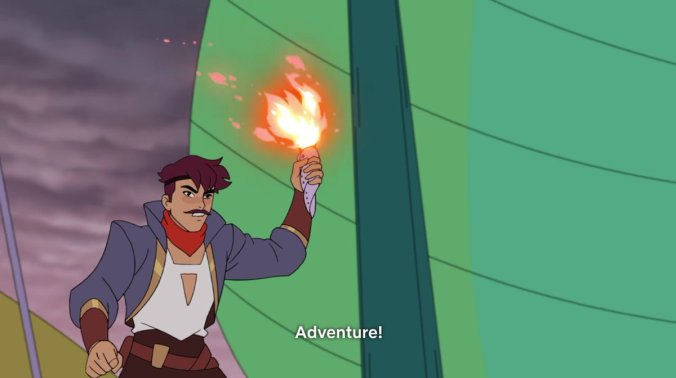
Cartoon of a pirate with a mustache holding a burning torch and the caption "Adventure"

Example Calls to Adventure:

  • Accident – happy or otherwise, an adventure can begin with an accident
    • On the train to school, Kaja’s phone runs out of battery and she has to ask someone else for their charger
  • Temptation – while the MC might have a mostly happy life, they do have desires (Remember needs and wants?) that could drive them to seek an adventure
    • Happily married Irene is tempted to spice up her vanilla lovelife
  • Herald – this is a person – friend, foe, or neutral – who brings the adventure to the MC in the form of an invitation, challenge, or summons
    • Friend – “Hey, did you see there’s an open trial for figure skating this weekend? Don’t you skate a little?” Jake asked.
    • Foe – Max yelled, “No girls allowed!” Laura ground her teeth and resolved to get into the clubhouse, no matter what.
    • Neutral – The pamphlet read: Free cookies with optional chess games in the library
  • Reconnaissance – the villain accidentally alerts the MC that trouble is coming while pursuing their nefarious agenda
    • Jones picked up the papers on Miller’s desk, scanning them intently, which was strange because he had no ‘need to know’ for that program.

Ready or Not?

Most of us are familiar with the reluctant hero concept. Adventuring is scary, uncomfortable, and may involve more than the usual amount of gastrointestinal upset. On the other hand, adventuring is exciting, heroic, and may involve amazing prizes.

In Refusal of the Call, I’ll delve into how MC’s react to the Call to Adventure and we’ll look at how eager would-be heroes can and do refuse their adventure’s call, too.

Refusal of the Call can happen in the same scene as the Call to Adventure, or different one, but as with the Inciting Incident, the scene(s) should err on the short and sweet side of writing.